If there's no conflict in the project team, we start to worry seriously. This isn't a joke, but a professional deformation: over years of working with IT projects, we've seen too many examples where external calm turned out to be just a beautiful wrapper for suppressed disagreements, passive aggression, and silent sabotage. Conflict in a living team is not a system failure, but a signal that people are invested, they care, and they see different ways to achieve the goal.
The problem isn't the conflict itself, but how the team handles it. You can pretend nothing is happening and quietly "move" the discussion to private chats and closed calls — then the tension will only build up. You can inflate any dispute into a small war, dragging in everything that's been accumulating for years, and end up hitting not the problem, but the people. Or you can treat conflict as a resource: a moment when the team honestly clashes different viewpoints to find a solution that can withstand the pressure of deadlines, budgets, and project constraints.
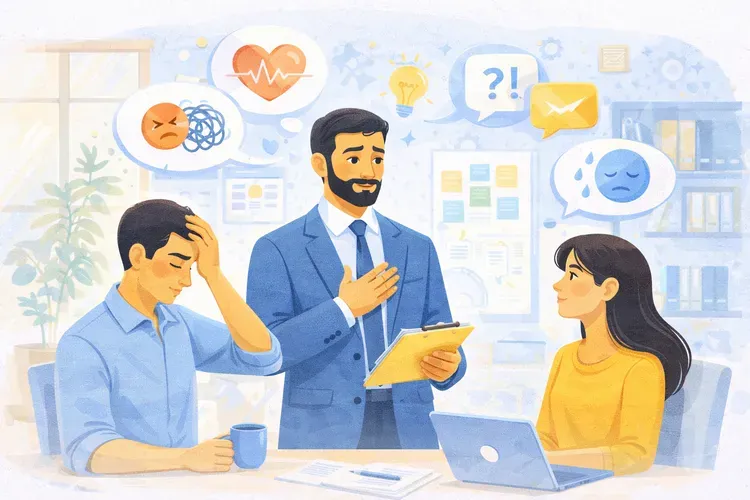
In the IT environment, conflicts often masquerade as "technical discussions." On a call, they seem to be discussing architecture, stack, or logging format, but after a couple of remarks, it becomes clear that it's no longer about which tables to add or which framework to choose, but about status, influence, and respect. The developer argues not with the idea, but with the fact that they weren't invited to the early discussion again. The analyst defends not the report scheme, but their right to influence the product. The manager defends not the release date, but the business's trust in their team.
We view conflict management as a separate managerial competency, on par with release planning, risk management, and stakeholder work. In real projects, it's precisely how the team experiences tough moments that determines decision speed, agreement quality, and ultimately the result in production. The good news is that conflict management can be learned — not through "textbook conflictology" theory, but through understandable practices, scenarios, and techniques that work in IT teams under load and deadlines.
In this article, we, as a team of practicing IT project consultants, compile our experience working with conflicts in project teams. We'll break down why conflicts are inevitable in the modern project environment, what distinguishes constructive clashes of positions from destructive wars, what practical techniques help smooth sharp edges without sweeping problems under the rug, and how to build a team culture where tough conversations become the norm, not a natural disaster. Our goal is to give you a set of tools you can use in the next sprint, without radically changing processes or turning every meeting into a psychological session.
Why Conflicts in Project Teams Are Inevitable
The first thing a project leader has to accept: conflicts are inevitable by definition. The more complex the product, the more roles and stakeholders, the higher the chance that interests, expectations, and worldviews will clash. A project is not a "smooth flow of tasks," but constant movement between time, budget, technology, and business requirements constraints. In such an environment, lack of conflicts often signals not harmony, but that someone has simply stopped telling the truth.
Within one team, people look at the project from very different heights and angles. Business and product owner think in metrics, market, and opportunities: "If we don't roll out this feature this quarter, competitors will overtake us." Development and architecture live in the world of technical debt, resilience, and risks: "If we add another crutch on top of crutches again, the system will start crashing at the worst moment." Operations and support think about how this will live in production later, and security — how to launch it at all without violating any mandatory regulation.
To this diversity of perspectives are added hard constraints. Deadlines are rarely set by the team, budget is almost never unlimited, some infrastructure and legacy systems were inherited "as is" and can't be rewritten in reasonable time. As a result, people who generally want the same thing — a successful project — end up in situations where any choice hurts someone. Conflict here arises not from "bad character," but from objective environmental pressure.
A separate layer is pace and constant changes. The backlog moves, priorities are reviewed based on the latest release results or competitor actions, the client adjusts the product vision mid-project. The team lives in "realign on the fly" mode, and different people have different tolerance for such turbulence. Some get drive from it, others feel chronic instability and fatigue. Against this background, even a small unaddressed issue easily turns into a serious clash.
The attempt to "ban conflicts" usually leads to the opposite effect. People stop bringing tension to general discussions but continue experiencing it, discussing in corridors, forming their "camps," and accumulating grudges. Externally, everything looks decent: meetings go as planned, reports match, no one raises their voice. But at a critical moment, the team suddenly can't quickly agree on a key decision, and years of unaddressed contradictions come out. So for us, the question is not how to make it so there's no conflicts in the team, but how to help the team experience them ecologically and use them as a source of development, not destruction.
Typical Causes of Conflicts in IT Projects
When we analyze conflicts in IT projects, in 90% of cases it turns out that the issue isn't "difficult people," but systemic causes. Different roles, vague expectations, constant deadline pressure, and constraints create a dense tension background where any trifle easily turns into a serious conflict. Below are the causes we see most often. Understanding this list alone helps the leader and team lead not to personalize every clash, but to look broader — at processes, agreements, and context.
Unclear expectations on results and deadlines. Classic scenario: the product owner confidently says "we'll make this release by month-end," the team nods, but everyone puts their own meaning into these words. For some, "make" means "roll out minimal working functionality," for others — "close all angles, including test automation and documentation." While everything is going more or less, differences aren't visible. But at the last moment, it turns out the client expected one thing, the team prepared another, and the manager is caught between two fires. Formally, no one meant to deceive anyone, but expectations weren't verbalized and aligned.
The same happens with deadlines. The phrase "very desirable to make by Friday" sounds to the developer as "if we don't make it, the world won't collapse," and to the manager as "if we don't make it, we have big problems with business." As a result, the team calmly postpones some tasks, and the manager panics explaining to the client. The conflict flares not at task assignment, but when the expectation gap manifests in reality. And the longer the team lives on hints, the more painful each such gap is.
Competing business and team priorities. Business needs to test hypotheses quickly, capture market window, "seize the moment." The team meanwhile sees technical debt, accumulated crutches, architecture at its limit. At the slogan level, everyone is for the same thing: "we want a successful product." At the decision level, the classic fork arises: do it fast or do it sustainably. If this fork isn't verbalized, the conflict becomes personal: "business doesn't think about quality at all," "developers sabotage and deliberately drag everything out."
This feels especially acute in projects where business decisions are reactive: today priority one is reports, tomorrow integration, the day after — new data dashboard. The team doesn't have time to realign context, loses trust in prioritization, and starts defending itself: "let's first finish what we started." If there's no transparent logic why priorities change exactly this way, the conflict quickly goes beyond professional discussion and turns into a struggle for control.
Technical disputes: architecture, stack, "beautiful" vs "on time." From the outside, such conflicts look like normal professional discussions: people argue which approach is better, bring arguments, draw diagrams. But the longer we work with IT teams, the clearer we see: in most "technical wars," under the surface lie issues of trust and influence. One architect has carried the system on their decisions for years and isn't ready to accept others' ideas. Senior developer doesn't believe juniors can suggest anything worthwhile. Team lead fears "non-ideal" solution will backfire on them.
At the same time, technical dispute is a convenient form to defend status and power without saying it directly. "It will be faster this way," "more reliable this way," "easier to maintain this way" — behind these phrases sometimes lies not so much real analysis, as desire to preserve the familiar worldview. The conflict heats up when sides stop hearing each other and start defending not the solution, but their own identity: "if we don't do it my way, they undervalue me." At this point, the dispute stops being useful for the project.
Role conflicts and "gray zones" of responsibility. In modern projects, pure role separation is rare. Product partially does analyst tasks, team lead takes some project manager functions, architect influences product decisions because "otherwise it won't fly." This is normal as long as the team consciously agreed on it. Problems start when boundaries blur spontaneously. Who makes the final call on priorities? Who sets task estimates? Who can say "no" to business?
When the team has several different answers to "who's responsible" for the same thing, conflict is almost guaranteed. People start either pulling authority or, conversely, shifting responsibility. The manager thinks the team lead "should have stopped everything," team lead is sure it's the product's decision, product looks at the manager. In such a situation, any project problem easily turns into a witch hunt, not joint problem-solving.
Different competency levels and "reality gap." In one team, there can be people with ten years of complex projects behind them and those who just graduated from courses yesterday. For the senior, it's obvious where it "smells like risk" and which decisions will explode in six months. The junior simply doesn't see it — not because they're "bad," but because they lack the experience. If the senior developer can't unfold their concerns into understandable arguments and limits to "can't do it this way" and "I told you so," to junior colleagues they look like someone who constantly slows down and complicates everything.
On the other hand, experienced specialists sometimes forget they also made mistakes and did "naive" things once. Instead of support and teaching, irritation and detachment kicks in. Juniors in response either start defending themselves or shut up and stop suggesting ideas. As a result, the team loses value from fresh perspective, and tension between "seniors" and "juniors" turns into a persistent generational conflict within the project.
Personal traits and mutual triggers. Even with ideal processes, people remain people. One speaks harshly and straightforwardly, without "wrapping," the other perceives such manner as attack. One is used to thinking aloud and arguing on the fly, the other ponders in silence and takes quick pressure as pressure. After a couple of iterations, each accumulates a set of triggers: "as soon as they start speaking in that tone, I already don't hear what exactly they're saying." The substantive part of the discussion disappears, only emotion remains.
Managers' common mistake is trying to "turn off emotions" and demanding people communicate "strictly business." In practice, this rarely works: emotions are still there, they just go underground and manifest through sarcasm, passive aggression, sabotage. Much more productive is to acknowledge that people have different communication styles and help the team agree on minimal rules: what's OK for us, what's not, which phrases and formats we consider unacceptable, how we give feedback.
Remote format and distributed teams. Online, conflict arises and develops differently than in the office. In correspondence, intonations aren't visible, a person can take a neutral phrase as an attack just because they're reading it in a state of fatigue. Responses come with delay, and in that time imagination manages to fill half the dialogue: "they're ignoring me," "they're doing it on purpose." Any understatement amplifies when people haven't seen each other live for a long time and perceive each other as avatars and texts.
Additionally, time zones and async work overlay. One person writes a message at their day end and waits for reaction, the other sees it only tomorrow. If the team has no agreements on which questions we resolve sync and which can wait, conflict easily accelerates on flat ground. People start demanding "immediate" reactions where it's physically impossible, and accuse each other of irresponsibility instead of tuning processes for distributed format.
Constructive vs Destructive Conflicts: Where's the Line
When we say "conflict can be useful," some immediately resist inside: "yeah, sure, useful when people growl at each other on the call." That's why it's important for us to distinguish two fundamentally different phenomena. On one hand — constructive conflict, when people argue tough but on substance, and as a result the team makes a stronger decision. On the other — destructive conflict, which burns trust, drains energy, and doesn't improve architecture, product, or processes in any way. The line between these states isn't always obvious in the moment, but there are signs to catch it.
What constructive conflict looks like. In constructive conflict, participants share a common goal — make the project better. They may disagree on the path, argue about approaches and priorities, but no one questions "we're still one team." People call things by their names, ask uncomfortable questions, uncover risks and weak spots in solutions. The tone can be emotional, but the focus stays on the task. The dispute ends with the team either finding a third option or consciously choosing one approach, understanding its pros and cons.
Constructive conflict has several hallmarks. Participants hear each other's arguments and sometimes clarify: "did I understand correctly that you're concerned about this?" People are ready to admit some counterarguments make sense, even if they stick to their position overall. After the discussion, relationships don't worsen, but may even strengthen: "we went through a tough conversation and figured it out." And most importantly — decisions the team reaches are actually implemented, not left as nice formulations on the board.
What destructive conflict looks like. Destructive conflict usually starts with a perfectly substantive trigger but quickly shifts to personalities. Speech includes "you always" and "you never," discussion moves from specific situation to accumulated grudge list. Arguments stop influencing the conversation flow: no matter how facts change, participants already have a ready explanation — "they're doing it on purpose," "they just don't care." At some point, people stop trying to solve the task and start fighting for victory, status, or justice in their own understanding.
If you look at such conflict from the side, characteristic markers are visible. More and more people get pulled in, though they have nothing to solve substantively. Formal meetings turn into field for direct or covert attacks. Some participants fall silent and stop speaking up to "not get under fire." The team disperses after the meeting not with an action plan, but with exhaustion and unspokenness. After some time, the conflict moves to chats and corridors, continuing to live its life.
Signals of transition from constructive to destructive phase. Rarely does a conflict start terribly destructive. More often it begins as normal professional dispute and gradually "slides into emotions." There are signals we as facilitators catch almost automatically. For example, participants start interrupting each other and arguing not with real words, but with attributed motives: "you just want to...," "you decided again to..." Speech includes generalizations and labels: "testers always slow down," "architects live in their own world."
Another signal — when people stop formulating what they want to achieve and focus on proving the other side wrong. At this point discussion freezes: arguments circle but solutions don't get closer. If nothing changes in conversation format, conflict almost guaranteed goes to personal level. Leader's and team lead's task here is to timely notice we're slipping into destructive and change the frame: return discussion to common goals, rephrase the question, set clarifying boundaries "what we're deciding now, what — later."
Why the goal isn't "avoid conflicts," but learn to keep them constructive. In projects we sometimes hear the request: "make it so the team doesn't conflict." Behind this usually lies fear of tension: it seems any tough conversation inevitably destroys relationships. Our experience says otherwise. The strongest teams we've worked with just know how to enter tough discussions without destroying trust. They have no fewer disagreements than others, but there's an agreement: we can argue about ideas, but don't cross to attacks on people.
If you try to remove conflicts as a class, honest discussions, willingness to openly talk about risks, and sense of involvement in decisions will go with them. People adapt: stop arguing at meetings, start formally agreeing, and voice real thoughts only in a narrow circle. As a result, decisions become superficial, risks hidden, team passive. So more realistic and useful goal is to develop in the team skills to keep conflict in constructive zone: ability to listen, rephrase, separate facts and judgments, timely pause and return to conversation in different tonality.
Role of Leader and Team in Conflict Management
When conflict flares in the team, the temptation is simple: find "guilty ones" and assign one person responsible for sorting everything out. In practice, such approach almost never works. Conflict management isn't a superpower of one charismatic leader, but a shared discipline of the entire project team. Yes, the project manager, team lead, or other formal leaders have a special role, but if other participants wait for "adult to come and reconcile everyone," conflicts will repeat in circles.
Project manager's role: hold the frame and rules of the game. From the project manager and other formal leaders, the team expects not that they'll always be "the wisest" in the dispute, but that they'll set a safe frame. This means several things. First, leaders formulate and verbalize communication rules: where we discuss disputed issues, what formats we use for tough topics, what we definitely consider unacceptable. Second, they ensure key discussions happen in transparent field: not only in private chats and hallway calls, but where decisions really impact the project.
Another part is prioritization and fixing agreements. Conflicts often flare around issues that shouldn't even be decided at specific developers or testers level. If the project manager doesn't clearly define "these decisions we make here, these — there," the team inevitably starts arguing about things beyond their power. As a result, people burn out, and the project still stalls. So important leader's task is to timely raise conflict to the level where it can really be solved.
Team lead's and direction leads' role: translate emotions into actions. Team lead usually is closest to team's daily life. They hear jokes, sighs, dissatisfaction in chats, see who stopped communicating with whom directly. Where project manager works with overall frame and stakeholders, team lead most often becomes the first to notice tension in the group is growing. And their reaction determines whether this tension turns into manageable conflict or goes into passive aggression.
Mature team lead doesn't pretend nothing's happening and doesn't take "they'll sort it themselves" position. They gently raise the topic: ask people in one-on-ones what's really bothering them, help name things by name, bring important issues to safe general discussion format. Their task is to translate emotions into understandable actions: "we're angry because priorities change mid-week for the third sprint in a row — let's honestly see what we can change in the process." This way conflict stops being personal story and becomes subject of joint improvement.
Every participant's responsibility: don't inflame and don't hush up. Easy to say: "let the leader sort it out." But conflicts in teams rarely arise only because "poor leadership." Every team member influences how the situation develops. You can consciously heat tension — retell others' words in harsher form, gather "support camp" around yourself, discuss people not solutions. Or conversely, help lower the heat: clarify what person meant, translate emotional remarks into facts, suggest taking disputed topic to separate conversation format.
There's another important responsibility part — don't hush problems until the last. When a person accumulates dissatisfaction for years without voicing it once, then "explodes" on flat ground, it's hard for the team to work with. We don't suggest turning every participant into psychologist, but consider important simple rule: if something systematically irritates or hinders work, sooner or later it needs to be said. Either directly to the person, or through team lead or manager, but not only as kitchen jokes and complaints in side chats.
Where healthy leadership ends and micromanagement begins. Sometimes leaders, having seen consequences of neglected conflicts, go to the other extreme — try to control all interactions in the team. Any dispute is immediately cut off, all tough topics moved to "we'll talk separately later" mode, any tension rise perceived as manager's personal failure. In short term it may create illusion of calm, but long term team loses ability to negotiate and resolve disagreements independently.
Healthy leadership in conflicts isn't total control, but creating conditions where people can go through tough discussions themselves, knowing that in critical moment they have support. Leader intervenes not in every dispute, but when seeing persistent pattern: topics aren't resolved but regularly surface; same people become "micro-targets" for attacks; individual participants are systematically ignored. In such situations leader's task isn't to "put everyone in place," but help team see what's happening and jointly rebuild rules of the game.
Conflict Prevention: Foundation for a "Healthy" Team
Conflict prevention isn't boring regulations and endless rules no one reads. It's a set of simple but systemic actions we implement in projects from the very start. They don't guarantee no conflicts at all (and shouldn't), but sharply reduce the probability that small misunderstandings grow into serious problems. We're talking about basics: clear goals, transparent roles, agreements on how we communicate, and regular opportunities to verbalize tension before it accumulates.
Transparent goals and priorities: what's important right now. Most conflicts in IT projects arise from unclarity "why we're doing this and in what order." If the team has no single picture why this task is first and this one fifth, each participant starts defending their version of priorities. Product sees business value, development sees risks and technical debt, testers see test coverage, operations sees maintenance complexity. Everyone is right in their own way, but without common frame, conflict of interests arises.
We start every project (or sprint) working on goals. Not abstract "make cool product," but specific: "in next three months we want to increase conversion by 15%, testing three hypotheses, without increasing system response time more than 200ms." Such goals immediately give understanding which compromises we're ready to take and which not. Priorities are reviewed openly: at grooming sessions or planning meetings we verbalize why something moved up, and give everyone chance to ask question or voice concern.
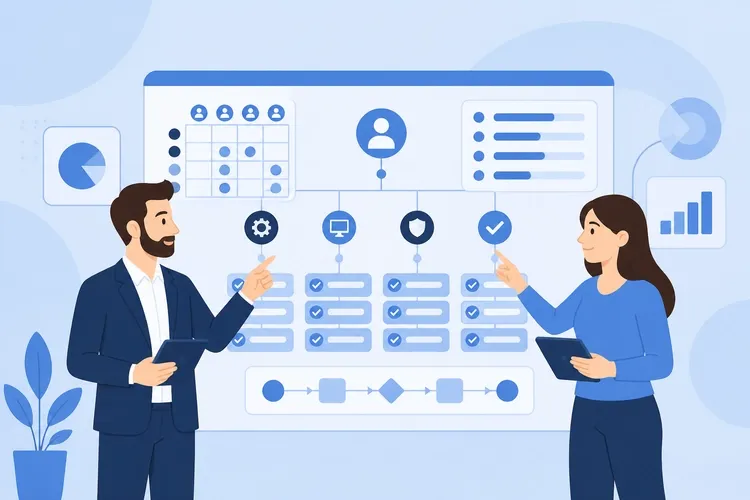
Roles and responsibility zones: RACI in human language. In large projects without clear role separation, conflict is inevitable. Who decides on architecture? Who sets task estimates? Who can say "no" to business? We use RACI approach (Responsible — executes, Accountable — responsible for result, Consulted — consult, Informed — inform), but explain it without extra bureaucracy. For example, make a simple one-page table: for key decision types show who participates and in what role.
Such table hangs in Notion or Confluence, discussed at project start and reviewed quarterly. It's not rigid matrix, but living document helping avoid typical situation: "I thought it's your zone," "no one asked me at all." When roles are transparent, people argue less about powers and focus more on task substance. Conflicts remain of course, but already not around "who has right to speak," but around professional decisions.
Team agreements: rules of the game. Best conflict prevention is to pre-verbalize how we conduct tough conversations. We hold special session (1-2 hours) at project start or when team changes significantly. Discuss: how we give feedback, what we consider acceptable in disputes, response time in chats, when we switch from correspondence to call. Working agreement examples: "If critical question not resolved in chat in 2 hours — call," "On daily meeting speak only facts and statuses, disputes take to separate meeting," "Feedback starts with 'I see that...' instead of 'you always...'."
These rules don't hang dead weight — reviewed periodically. If someone violates agreement, team lead or manager gently reminds: "We agreed to discuss such questions at general call." This creates culture where tough topics don't go to private chats and corridors, but resolved openly. People know they have safe format for disputes and fear less to speak up.
Regular syncs: daily meeting, weekly, retrospectives. Regular short meetings are team state thermometer. Daily meeting (15 min) helps catch small misunderstandings before they grow. If developer says "I have blocker on API" and backend silent — tomorrow team lead knows need to intervene. Weekly sync (30-60 min) — time to check priorities and verbalize accumulated questions. Retrospective every sprint — chance to honestly discuss what's hindering work.
Key here isn't formality, but real openness. We teach teams to start retrospectives not with "what was good/bad," but questions: "What slowed us most?", "Where did we waste energy?", "What each of us could do differently?" Such approach helps find systemic tension knots (too many approvals, unclear tasks, overlapping responsibility zones) and unpack them before escalation to personal conflicts.
Feedback culture and psychological safety. People won't talk about problems if they fear consequences. So from the start we set tone: here it's ok to err, argue, ask for help without fearing to look weak. Simple practices: team lead regularly holds one-on-ones (15-30 min weekly), asking not only about tasks but feelings: "What's stressing you in current pace?", "Any moments where you feel unheard?" "Any colleagues interaction got harder with?" Important not to pressure: if person goes to "all fine," don't dig immediately, just note and return to topic in a week.
On team meetings encourage phrases like "I'm not sure, but it seems to me..." or "might be wrong, but here's what I see." Psychological safety builds not through words but actions. When leader admits own mistakes themselves ("I overestimated sprint volume, everyone overworked because of it"), team sees it's safe. When tough question brought to discussion and no one gets hit for inconvenient opinion, trust grows. In such teams conflicts happen, but less often go to destructive phase because people know: they'll be heard, not punished.
Conflict Diagnosis: When "Something Went Wrong"
Conflicts rarely start with explosion — scandal on call or public sabotage. Usually they mature quietly, manifesting through small symptoms: silence at meetings, sarcastic jokes, task shifting. If leader or team lead catches these signals early, conflict can still be turned into constructive discussion. If ignored — in couple weeks small frictions turn into persistent tension hard to unpack. We've learned to see emerging conflicts by three marker groups: behavior, processes, and emotions.
Behavioral markers: silence, passive aggression, sabotage. Most obvious signal is change in communication. Someone who used to actively argue and suggest ideas suddenly falls silent at meetings. Another starts responding monosyllabically or delayed. Third sprinkles "jokes" with irritation undertone: "yeah sure, everything last minute again." In chats emoji-reactions replace normal responses, personal messages to colleagues — "hey, what's up with your task?" — stay unanswered.
Another marker is polarization: team implicitly splits into "ours" and "theirs." People stop communicating directly, retell others' words through third parties: "he said it's not his problem." If team lead notices task discussion goes to correspondence between two instead of general channel, it's already alarm bell. People avoid open space because it's uncomfortable to argue or ask help there.
Process markers: deadline misses, "eternally burning" tasks. Conflicts always show in metrics. Tasks start "burning" not due to objective complexity, but because people stop helping each other. Developer doesn't answer tester's bug question not because busy, but "let them figure out themselves." Backlog bloats because priorities no one can agree on. Sprints end at 60% completion though estimates were realistic.
We look at indicators like tasks spilling between sprints, code review time growth, incidents by same cause. If testers write in tickets "same errors again, how many times," and developers reply "write spec more detailed" — it's not about process quality, but mutual distrust. Such patterns show conflict already impacts work speed and quality.
Early diagnosis tools: one-on-one, check-ins, anonymous surveys. Most effective way to catch conflicts is regular one-on-one talks. Team lead or manager asks not "how's tasks?" but "what's stressing you in current pace?", "any moments you feel unheard?", "any colleagues got harder to interact with?" Important not to pressure: if person goes to "all fine," don't dig right away, just note and return to topic later.
At team level work short check-ins at meeting starts: "is everyone comfortable under current load?", "any questions we're postponing?" For deeper slice we do anonymous surveys every sprint: "what hinders efficient work?", "hardest to interact with whom?" Aggregate responses and discuss without names. Such approach brings hidden tensions to open field without escalating to public discussion of specific people.
Quick diagnosis checklist. When it seems "something's off" in team, we use simple 10-question list. Answer yes/no and count points:
- New closed chats or private correspondence on work issues appeared?
- Response time to colleague requests grown (over 4 hours)?
- More tasks spilling from sprint to sprint?
- Generalizations like "you always/never" sound more often?
- Someone active silenced or conversely started dominating?
- Bugs growth by same cause?
- Less cross-help between dev, QA, analytics?
- More jokes/comments with irritation undertone?
- Activity drop at retrospectives?
- Overwork growth without visible cause?
If "yes" over five — time to act. Not exact science, but gives leader objective base not to react to every sneeze and not ignore systemic problems.
What to do with diagnosis results. Finding conflict signs is half the job. Important not to rush "unpack bone by bone," but choose intervention scale under situation. If tension between two people — start with their one-on-one or three-way meeting. If half team affected — gather general call with clear frame. If systemic knots visible (wrong load, unclear roles) — work with processes, not people. Key rule — start with what can really influence, not sharpest accusation.
Conflict Map: Parties, Interests, and Root Causes
When conflict is already visible, first impulse is gather everyone and "sort it out." In practice such approach rarely works: emotions high, positions dug in, time limited. We always start with diagnosis — decomposing conflict into components. Conflict map helps see not only "who argues with whom," but what really stands behind surface accusations. It's like X-ray: shows problem root, not just symptoms.
Conflict parties: who's really involved. First thing we do is define who directly affected by problem. Often 8-10 people argue, though conflict concerns two-three. Others resonate ("same happened to me") or act as advocates ("my friend is right"). We draw simple scheme: circle in center — dispute essence, around — direct participants (mark their real interests), further — observers. Those not influencing decision we ask to refrain from comments for now.
Example from practice: dispute whether rewrite legacy module or wrap in proxy. Direct participants — two architects and backend team lead. Testers jumped in ("if rewrite, tests fly") and product ("deadlines burn"). We stopped everyone except architects and team lead, first unpacked their positions. Others got observer role with right to questions at end.
Positions vs interests: what person says vs what they want. People in conflict rarely speak about real interests — they defend positions. "I want to rewrite module" — position. Interest behind may be any: "fear proxy won't handle load and I'll get fired," "believe clean code pays off in half year," "don't want lose two weeks refactoring before release." We ask each fill three columns: "What I want (position)," "Why important (interest)," "What I fear if not."
Such technique uncovers that behind seemingly opposite positions often lie compatible interests. Product wants deadlines, architect reliability. Instead of position war appears compromise search: proxy prototype in three days + rewrite plan after release. Without positions/interests separation conflict stalls in "either-or" dead end.
External constraints: what hinders everyone together. Conflicts rarely purely internal — objective frames accelerate them. Budget not rubber, client changes requirements, legacy can't rewrite in sprint, team on vacation. We always start unpack with question: "What hard constraints each side has?" List external factors write on board and check "can't change." Rest — maneuver field.
Typical IT constraints: release date, system SLA, contractor budget, team headcount. When visible to all, dispute stops being personal: "yes, proxy compromise, but release in 10 days, rewrite takes month." Awareness of common frames reduces mutual accusations and translates conversation to constructive channel.
Conflict type: value, resource, role, communication. Understanding type makes choosing resolution technique easier. Value conflict ("quality over speed") resolves through prioritization and compromise. Resource ("5 devs for 10 tasks") — through redistribution or client expectations. Role ("who decides architecture?") requires clear power boundaries. Communication ("I don't understand you") — active listening techniques.
We use simple 4x4 matrix: rows — conflict type, columns — signs, intensity, recommended techniques. E.g., value + high intensity = facilitated meeting with voting. Such classification helps leader not reinvent wheel but take ready algorithm for situation.
Basic Conflict Management Strategies
Conflictology has five classic strategies (Thomas-Kilmann model). We've adapted them for IT projects: added context when each works, and typical mistakes. No "universally best" strategy — choice depends on urgency, decision importance, team relationships, and conflict stage.
Avoidance: conscious "not now." Works when conflict concerns trifles or decision postponed. Example: code style dispute before release. Instead of hour discussion team lead says: "Fix current style, discuss linter after release." Mistake — chronic avoidance: problems accumulate, then explode together.
Smoothing: "let's find common ground." Appropriate for low importance question or when need preserve relationships. Product pressures speed, dev quality. Leader: "Agree, both important. Do MVP fast, polish next sprint." Mistake — constant concessions one side: breeds grudge and injustice feeling.
Compromise: quick decisions with losses. When time limited, decisions important. "Can't rewrite, no time. Do proxy but allocate 20% sprint for refactoring." Compromise not ideal but allows movement. Mistake — compromise on all issues: solution quality falls, team burns out.
Collaboration: "win-win" through interest integration. Ideal for important long-term decisions. Requires time and trust. Technique: each writes 3 solution variants, team votes, best combine. Works in mature teams. Mistake — forcing collaboration in hot conflict: goes to endless disputes.
Forcing: "we decide this way because..." Emergency situations, project safety. Leader: "Release in 3 days. Use proven stack, experiments later." Justification mandatory or undermines trust. Mistake — frequent forcing: team demotivates, stops suggesting ideas.
Conclusions for Leaders and Teams
Conflicts in IT projects aren't enemy but working material. They show where processes limp, roles blur, expectations diverge. Leader's task — teach team to see in conflicts not threat but improvement opportunity. We believe: good team argues no less than bad one, but knows how to return dispute to common goal channel.
Start small: hold team session on agreements, set regular one-on-ones, learn catch early tension signals. In 2-3 sprints you'll see how team starts unpacking conflicts themselves without waiting your intervention. That's maturity — when tough conversations become culture part, not exception.
Conflict management is managerial competency on par with planning and risks. Invest consciously, and your projects become not only technically successful but people-resilient.
Get Consultation